

MATRIX OF WORK - Materials on the history and future of work
The »MATRIX OF WORK« provides a interdisciplinary »big picture« and surprising insights into the global history of human work from its beginnings to the end of the 21st century - from the hand axe to the humanoid robot, so to speak. The work has been compiled by an interdisciplinary team at the Institute for the History and Future of Work (IGZA) since 2016 and is characterised by its »broad view«, which opens up new perspectives for dealing with the present and future of work.
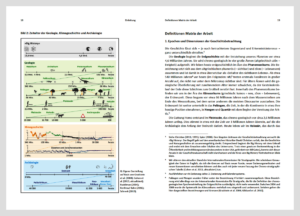
In the spirit of a 'matrix', the work comprises both an intensive analysis of the essential structural elements of the Epochs of work - the life and work of wild hunters in the first 300,000 years of human history, the agricultural era from its beginnings 10,000 years ago and finally the emergence of hierarchical agricultural empires 5,000 years ago and the era in which we live, the capitalist market economy and mode of production and finally a consideration of the work of the future - as well as an examination of long lines of essential Dimensions across epochal boundaries.
On the basis of 1 143 colour graphics, maps, tables and time tables as well as current figures and research results from economics, sociology, archaeology, anthropology, climate research and many other disciplines, the development of the productive and destructive forces of work and their influencing factors is traced from an interdisciplinary, global-historical perspective: the history and future of work as part of human history in the field of tension between poverty and wealth, the risks of work, technology and science for people and nature, as well as the opportunities to transform our excessive finance-capitalist investor economy into a sustainable, solidarity-based market economy. After all, work will not only change in the future as a result of digitalisation and automation. It is also about the question of how much ecologically and socially ruthless work we can still afford and whether we will succeed in developing a common, global awareness of the challenges ahead.
Contents
Volume 1: Early history of work
Volume 2: The agricultural epoch
Volume 3: Capitalist market economy and mode of production
Volume 4: The future of work; synthesis
Volume 5: Major trends -
1 Climate
2 Population
3 Work organisation
4 Division of work and qualification
5 Work, technology, science
6 Working hours
Volume 6: Major trends -
7 Unemployment
8 Poverty and wealth
9 Patriarchy
10 Dominion
Volume 7: Data manual
»These «materials' open up a broad view of the history and future of work as part of human history. The seven volumes are a rich source of facts and analyses from economic and social history and should provide new insights and stimulating perspectives for anyone interested in the future of work and sustainable prosperity."
Jürgen Kocka
Reviews

The Archive for Social History Volume 64 (2024) contains the following Review essay published:
Jürgen Kocka: Long-term history of work and its productivity. Review essay on: IGZA (ed.), MATRIX OF WORK - materials on the history and future of work.
Published im Archive for Social History, Volume 64 (2024): Migration in the Modern Age, Paths - Places - Experiences, page 455-464
→ Review essay (PDF, 10 pages)
→ Archive for Social History (AfS) (Website)
→ Table of Contents AfS Volume 64 (PDF, 5 pages)
→ Archive of Social Democracy (Website)
The „matrix of labour“ includes various Meetings which we would like to draw your attention to:
Herbert Schaaff
- in business and society: Book review - The history and future of work (Economy and Society 49 (4): 103-110)
Peter Kern
- in Jungle World: The matrix of work and how to free yourself from it (08.02.2024)
- in Gegenblende (DGB): The Good Work Manifesto (12.10.2023)
- in Faust culture: Matrix of living labour, reloaded (09.10.2023)
- in splendour & misery: »Travail attractif« (06.10.2023)
Klaus Lang
- in Sozialismus.de issue 1/24, double review of Axel Honneth „Der arbeitende Souverän“ and IGZA „Matrix der Arbeit“: Prosperity for all and liberated work: clear goal - difficult path (04.01.2024)

MATRIX OF WORK
Issue
7 volumes in a slipcase
1 143 Graphics, images, timelines and tables
in high-quality 4-colour offset printing
Chronological tables at the front and back of each volume
Climate-neutral printing, FSC-certified paper
Natural brochure cover
Large format (26 cm x 19.5 cm)
.
Published by J.H.W. Dietz Nachf., Bonn
245,00 Euro
ISBN 978-3-8012-4286-2
Published: August 2023
Available in your local bookshop or free of charge via the Bücherwurm bookshop in Gaggenau: Webshop (please select „Pick up“ as delivery option, the books will still be sent immediately by post to the specified address).
The 7 volumes in detail
VOLUME 1: EARLY HISTORY OF WORK
The first volume is divided into two sections: Introduction and Early History of the Work. The introduction provides an overview of the main research interests of the entire work. The dimensions and epochs under consideration are presented. Our approach is based on comprehensive empirical data from economic and social statistics, archaeology, ethnology and global history research, along which we present the long lines of the history and future of work as part of human history.
The origin of man and work
In the main part of Volume 1, we start chronologically at the very beginning. We take you on a short journey back in time to the emergence of modern humans and the roots of labour, language, thinking, collective learning and social interaction. Based on the findings of evolutionary research, palaeoanthropology, archaeology and brain research, questions are raised about the evolutionary development of human 'nature' and our legacy from this era. Delve into the origins of our existence and discover how the history of work is inextricably linked to human evolution.
Scarcity and abundance
Modern humans have been around for 300,000 years. Nothing distinguishes us today from our ancestors at that time. For most of these 300,000 years, until the beginning of a new epoch around 10,000 years ago, people lived in small, manageable communities as game hunters. What they needed to live was gathered from nature, hunted and processed into food, clothing, dwellings and tools, as well as jewellery, instruments and art and cult objects. You will learn how life was characterised by the »scarcity and abundance« of natural conditions, but free from war, hierarchy and patriarchy.
VOLUME 2: THE AGRI-CULTURAL EPOCH
Welcome to the second epoch in the history of labour, which fundamentally changed humanity's economic system around 10,000 years ago and, from around 5,000 years before today, revolutionised social coexistence on the basis of a small, agricultural surplus.
Transition to the domestication of plants and animals
Volume 2 begins with the upheavals at the end of the last ice age. Triggered by growing population pressure, people began to domesticate plants and animals. The first early agricultural communities emerged during this period. We look in detail at ethnological and archaeological evidence to understand the causes and consequences of this transition. Humans became more sedentary and laid the foundations for the complex agrarian societies that emerged from around 5,000 years ago with the new economy based on plant cultivation and animal husbandry.
The 5,000 transformation: Scarce wealth - civilisation and barbarism
Around 5,000 years ago, the way we live together changed forever. What is still described in many history books as the emergence of »civilisation«, the emergence of writing, theatre, literature and legal texts, of specialised professions and fantastic achievements of human labour such as the pyramids, of philosophy and mathematics as well as ornate gold and silver jewellery, is only one half of the reality. Using unique figures on agricultural productivity, we can show that metalworking, the plough and draught animals, large irrigation systems, mathematics, astronomy and much more created the basis for a systematic surplus. However, this new wealth was scarce, so that this era is also inextricably linked not only with civilisational achievements, but also with the emergence of new »barbarism«, exploitation of people as slaves and tributary subjects by the hierarchy, with war for empire building and patriarchy as social institutions, which are still with us today!
VOLUME 3: CAPITALIST MARKET ECONOMY AND MODE OF PRODUCTION
The third volume centres on the last 250 years - the era in which we live today: In the capitalist market economy and mode of production that revolutionised the productivity of human labour and the way we live together.
In the first three chapters, we explore systematic questions about the market economy, capitalism and its growth logic, as well as the unstoppable dynamics of labour automation and sectoral change.
Explosion of productivity
In one hour of work, a person in the most developed countries can now produce around 90 times as many goods and services as by manual labour - an incredible explosion in productivity compared to agriculture, whose scarce wealth was fed by a productivity level of only around three times that of manual labour. The comprehensive presentation includes key dimensions that interact with labour. It also includes concrete examples at key turning points, for example from Richard Arkwright - one of the 'inventors' of the modern textile factory - to John D. Rockefeller - one of the most important business leaders of the first large corporations - to Blackrock - one of the most powerful asset managers in the world, exemplary of the power of investors in the age of financialisation and digitalisation.
Expansion of emancipatory and destructive potentials
The rest of the volume not only describes the 'ingredients' that made the unleashing of productivity possible. It also deals with the emancipatory aspects such as the increasing prosperity of the working population, the shortening of working lives with simultaneously increasing life expectancy or the first tendencies towards the dissolution of patriarchal structures, but also with the dark sides of this development such as the overexploitation of people and nature and increasing inequality.
VOLUME 4: THE FUTURE OF WORK
In the fourth volume, we turn our attention to the future of work. The time horizon is the year 2100, i.e. the next 75 years. From an everyday perspective, this seems like a long time, but it only covers the duration of a human life. Children born today will live to see the next turn of the century.
The end of work? Sustainable work!
At the beginning of the 21st century, with its multiple ecological, economic and political crises, wars and ever-increasing inequality, the consequences of overexploitation of people and nature are clear to see. We are living beyond our means. The first part deals with the topics of material prosperity, energy and the environment, population, climate and resources, i.e. the connection between the explosion in productivity and ecological sustainability. At the same time, however, we are also living below our means. The second part deals with the qualitative core of work. What is 'good work'? What is the relationship between work and technology in the digital age? And what does this mean for qualifications and training? The third part deals with the socio-ecological transformation and a new understanding of productivity. Extensive statistical material provides an insight into global structures and the inequality of relations between and within the countries and regions of our world, especially between the Global North and South.
Synthesis: end of scarcity, realm of freedom
In the synthesis, we summarise the essential structural elements of the empirical-historical passage through the history of work. We show the great, but preconditional potential that will arise in the future - on the basis of high and increasing work productivity and a solidary and ecological orientation of economic activity - for the solution of the economic problem (end of scarcity) and a solidary, democratic society and sustainable, fulfilling work for all (realm of freedom).
VOLUME 5+6: MAJOR TRENDS
The first four volumes are chronological cross-sections. In line with the idea of a 'matrix', volumes 5 and 6 take a longitudinal look at the major themes and trends.
The observation begins with 'Climate' and 'Population', as the emergence and development of Homo sapiens is closely linked to climatic changes. Throughout almost all of history, dependence has only run in one direction: nature ➝ man. For at least 250 years, however, the direction has been reversed and we are massively and globally influencing nature, climate and the environment (humans ➝ nature) - fatally to our own detriment or even demise.
Then core categories of work – work organisation', 'Division of labour', 'work, technology, knowledge (science)' and 'working time' - with its milestones. Graphics, timelines, images and tables illustrate these long lines of work.
In the big trend 'unemployment' looks at the development from the beginnings of forced non-labour, which in the case of landlessness was a threat to livelihoods even 5,000 years ago, to the solidarity-based protection provided by social insurance systems.
The development of the standard of living and its distribution will be reflected in the major trend 'poverty and wealth'from 300,000 years of »scarcity and abundance« to life in »scarce wealth« in 5,000 years of hierarchical-imperial agrarian societies to the potential of an »end of scarcity«, i.e. secure prosperity for all, which has been achieved in the last 250 years on the basis of the explosion in productivity.
The last two major trends are dedicated to 'Patriarchy' and 'Hierarchy' Specific features of the last 5,000 years that still have a formative effect today. At the centre is the amalgam of the continuing structures of the agrarian era and the upheavals of social structures with the capitalist market economy of the last 250 years, with the beginnings of democracy in work and society and - after the first intensifications - the beginning of the dissolution of patriarchal structures.
VOLUME 7: DATA MANUAL
The final volume 7 is the statistical centrepiece of the matrix materials.
Data and methods
In the first part you will find the central data tables on topics such as population, labour force, production, productivity, working hours, unemployment, distribution and consumption as well as the environment. Explanations of the tables and methodological explanations are also included. In the 'Distribution and consumption' section, the concept of consumption baskets is explained in detail. This makes it possible to describe the development of living standards across epochs, starting with the absolute subsistence level basket of goods as a basic unit that contains only what is necessary for survival. You will also find a list of abbreviations, measures and units of account at the beginning of the volume.
Sources
In the second part, we present the most important sources that have been incorporated into the matrix materials. These represent the current state of research from the disciplines of economic and social statistics, archaeology, ethnology and global history research. The sources include institutions such as the UN, the OECD and Eurostat as well as national statistical offices and historical-empirical research - from pioneers such as Colin Clark and Angus Maddison to current projects such as the World Inequality Database, which builds on the work of Thomas Piketty and others.
This volume concludes our journey through the history and future of work. We believe that we can offer all those interested in the history and future of work good statistical tools for a wide range of applications that transcend specialist boundaries. We hope that this comprehensive presentation and the rich material of data, charts, timelines and analyses will not only provide you with knowledge, but also with ideas for further discussion and research.

Structures
Take a look at the structure of the seven volumes:
- detailed structure
Contents, 7 pages (PDF) - Compact structure
Overview, 1 page (PDF)
Presentation
You can find a review of the presentation of the »Matrix of Work« in Berlin in September 2023 here.

Time tables
Informative time tables are an integral part of the Matrix edition. They can be ordered from the IGZA in printed form at cost price. You will find information on this here.